
01 / Artificial Polemics
AI! Burn Him; or,
De l’art de l’argument paresseux
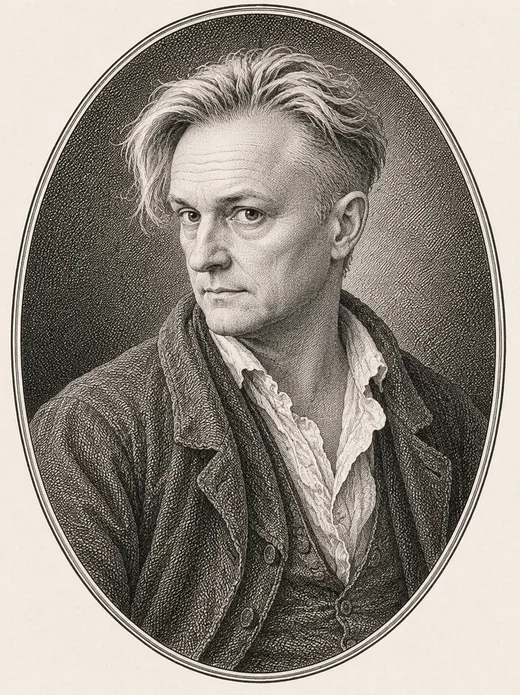
If you came here looking for an essay about how AI made my writing better, turn back now.
A writer isn't just someone who puts words on a page. A writer gets those words in front of readers. And I use artificial intelligence to do that.
There. I said it.
I’m aware, depending on where you spend your time on Reddit, this confession could require me to surrender the author card no one has ever issued me, confirm which paragraphs were written by Skynet, apologize to every copyeditor displaced since 2022, or submit my prose to one of those services that claims to know with 80% certainty whether a human being wrote it.
That last magic technology makes me especially nervous, because I’ve apparently been writing like artificial intelligence since sometime around the eighth grade.
I like parallelism. I make arguments in threes. I use balanced clauses. I have an unhealthy fondness for constructions that begin by telling you what something isn’t before telling you what it is. I was taught to write essays with an introduction, three arguments, and a conclusion, and then to construct each argument out of supporting points arranged in some recognizable order. Apparently several decades later we trained machines on such an enormous quantity of our middle school writing, the machines noticed that humans do these things, and now doing them is evidence that you might be a machine yourself.
WITCH! BURN HIM.
How many of us have actually caught ourselves changing sentences we wrote because we thought they sounded too much like AI? Not because they were bad sentences. Not because they weren’t ours. Because we were afraid someone might think they weren’t ours. I know I’m not alone, I hang out on r/writing, too.
I’ve decided this is an absolutely insane way to live. And I am here to confess my sin: I use AI when I write.
My confession comes despite an increasingly loud and distressingly lazy argument about artificial intelligence, particularly when it comes to writing. We’ve taken an enormous spectrum of possible uses—from asking a grammar checker whether a comma belongs in a sentence to asking Copilot to research an unfamiliar subject, Gemini to poke holes in an argument, Claude to tell you why a chapter isn’t working, ChatGPT to troubleshoot a website, or, yes, any of them to write for you—and collapsed all of that into the category “AI USE.” And, as if that wasn’t bad enough, we started shouting at one another from opposite ends of the battlefield.
So I would like to propose a radical question: Where’s your line?
If someone asks an AI to write a book and then puts their name on the cover without disclosing that AI wrote the book, I happen to believe that’s dishonest. That’s where I draw a line. Not the line. A line.
Now tell me where you want to put yours.
Should an author use AI for research? Outlining? Brainstorming? Copyediting?
Can a writer use AI to test an argument? To compare two versions of a paragraph and explain what changed? To read a chapter and report where attention wandered? To identify an inconsistency? To explain why a thesis isn’t landing? To argue that a joke is cheap until the writer gets irritated and spends twenty minutes defending it?
Those aren’t the same activities, and pretending they are doesn’t make the ethical question easier. It just saves us from having to think about it. Or, even better, it gives us a reason to argue about it.
I confess: I use AI for most of those things, although the exact line moves depending on what I’m doing. I wrote every word of my first book myself. And I also used artificial intelligence extensively while making it. Both of those sentences are true.
WITCH! BURN HIM.
I am a self-published author, which means that in addition to writing the words, I somehow became responsible for editing workflows, jacket production, distribution, metadata, website development, SEO and GEO, marketing strategy, publicity, ISBNs, print specifications, and a surprising amount of DNS configuration. Traditional publishing houses employ people who know how to do these things. I employ me. Employ is doing a lot of heavy lifting, I don’t also pay me. Yet.
Artificial intelligence didn’t make me a publishing professional. It gave me access to capabilities that previously would’ve required money, expertise, connections, enormous amounts of self-education, or some combination of all four.
My author website competes perfectly well with professionally produced websites. In some cases, I think it’s better. I have developed a marketing strategy for my book that doesn’t look completely ridiculous sitting beside the plans created for authors at traditional houses. I have researched unfamiliar technical problems, understood enough of them to make decisions, implemented the solution, tested it, discovered I broke something, swore a lot, and tried again.
Before AI, I doubt I would’ve hired professionals to do all of this. That’s one of the assumptions I find particularly shortsighted in the argument that every task I perform with AI represents work stolen from somebody else.
The alternative to using AI wasn’t necessarily hiring a web developer. The alternative might have been buying HTML for Dummies, spending a weekend learning enough to be dangerous, and eventually getting the website online through a combination of Google, Reddit, the IT guy at work, profanity, and luck.
That’s the generous version. But the likelier one is that I wouldn’t have attempted the rest of it at all. A manuscript in a drawer, and a man in his La-Z-Boy with the soaps on and a box of bonbons, having concluded that publishing was a thing that happened to other people. Nobody’s job is protected by a manuscript in a drawer. That’s the counterfactual that matters.
Artificial intelligence has lowered the cost of attempting things. That doesn’t make anyone good at them. Or guarantee success. Or turn an amateur into an expert.
It reduces the structural cost of becoming a credible participant.
Self-publishing had already democratized access to the means of publication well before I came along. Anyone with a manuscript and enough determination could make a book. What AI is now beginning to democratize is some of the institutional capability surrounding publication.
The playing field isn’t level by any means. A major publishing house still has the money, staff, distribution relationships, publicists, designers, editors, and institutional reputation, among other things. But the shape of the field has changed. Self-published authors now have access to tools that make us more credible competitors.
But getting onto the playing field and winning on it are different things.
Distribution matters. Discoverability matters. Money matters. Advertising, pricing, reputation, relationships, and dumb luck all matter. AI has helped me compensate for some of those disadvantages too. That’s part of the point.
But eventually another human being still has to want the thing I’ve made.
Artificial intelligence can increase my capability without increasing my competence. It can help someone like me produce a beautifully packaged book with an impressive marketing channel.
And my book can still be shit.
The website can be gorgeous. The metadata can sparkle. The research can be impeccable. The DNS records can propagate from here to Paris.
And the reader remains perfectly capable of opening the book, reading three pages, and deciding they’d like their money back.
AI expanded what I could attempt. It hasn’t granted me the right to succeed at it.
This isn’t particularly new, neither are the arguments. Technology has been lowering the cost of human activity since we figured out that fire was useful for things besides standing around and admiring fire. The printing press lowered the cost of distributing ideas, including stupid ones. Email eventually gave a Nigerian prince global distribution without requiring him to lick a single stamp.
Artificial intelligence has lowered the cost of fraud too. Of course it has. Bad actors benefit from technological leverage for exactly the same reason everybody else does. And they always have. And always will. They’re human.
The risks are not imaginary. AI has made fraud cheaper, faster, more convincing, more personalized, and easier to scale. Deepfakes have created problems we’re only beginning to understand. Propaganda that once required entire warehouses full of Russian trolls spending ten hours a day pretending to be Americans on Twitter is now manufactured at volumes Vladimir could only dream of.
There are serious questions about copyright, employment, energy use, water management, misinformation, education, dependency, and what happens when enormously powerful systems are controlled by a small number of enormously powerful companies.
And men.
Copyright is the one that hits a little close to home for me.
There’s a sentence on the copyright page of my own book that says, in its entirety: “No part of this book may be used or reproduced for the purpose of training artificial intelligence technologies or systems.”
I know, right? That’s an interesting position for someone quite a lot of words into an essay about how useful artificial intelligence has been to him.
I’d like to tell you that disclaimer represents agonizing hours of careful reflection on intellectual property, creator compensation, fair use, and the moral rights of authors. But my hypocrisy knows no bounds, and the truth is I don’t want my own digital assistants training on my writing because I have a strong suspicion it will eventually come back to bite me in the ass. I don’t want to help my machine overlords get better at arguing with me.
Besides, I already have people deciding the perfectly ordinary things I write sound like AI. My book club doesn’t need more of my habits of structure and rhetoric than it already has. Feeding it my actual writing seems like a particularly efficient way to make the problem worse.
But my stupid personal reasons don’t make the underlying question stupid: If I believe I should have some say over whether my book is used to make generative artificial intelligence better at producing language, what do I owe the writers whose work may have helped make the systems I use better at producing language?
And that’s an argument I don’t have an answer to. I’m leaving it open, not because it’s unimportant but because I can’t close it, and I’d rather argue it than pretend. In the meantime I keep using the machines, which is a choice and not a verdict, and the least I can do is make the choice in the open: the disclaimer on my copyright page, this essay, and an honest account of what the machines did to it.
“This technology has been used to do terrible things” can’t be the end of the argument either. Refusing to use fire because people once burned witches with it would be an extraordinarily strange lesson to take from the history of witch burning. That doesn’t address the question of how the machines are made or whose work goes into making them. Prior harm is a different objection, and it is not, by itself, an argument against every use.
The lazier arguments are easier. “It’s just a tool.” Tools have consequences. The printing press didn’t merely allow knowledge to disseminate. It disseminated bullshit. The internet gave ordinary people unprecedented access to useful information and unprecedented access to people explaining that vaccines contain tracking devices. Transformative technologies create opportunities, destroy arrangements, disrupt existing systems, redistribute power, and produce consequences their inventors couldn’t anticipate. We humans then engage in our time-worn practice of figuring out the rules several decades after everybody has started using the thing.
One of the consequences you hear about most often is that AI is making us dumber. Maybe.
But hasn’t technology always appeared to do that?
I’m certainly worse now at remembering phone numbers than I was when I was twelve. I used to carry a small directory in my head. Not because I wanted to, because I had to. Now someone can bump their phone against mine, purposefully or not, and I have all the information I need to call them at three in the morning for the rest of my life without ever learning the digits that make that possible.
Something was lost there. I’m just not convinced it was intelligence.
The internet went and changed the value of possessing information. When information was difficult to acquire, remembering it was extraordinarily useful. As information became easier to retrieve, some of the cognitive burden shifted. I no longer needed to remember everything if I knew where to find it.
AI is now pushing that shift further, and it has also changed something important about retrieval: Information can answer back.
If I don’t understand a book, I can still interrogate it, but the interrogation is lopsided. I can think questions about his writing at Denis Diderot all night long. Diderot remains inconveniently dead.
Google improved the situation considerably. I can ask a question and receive thousands of possible sources. But Google largely leaves the intellectual synthesis to me. I search, open tabs, read, search again, compare sources, close the fucking popup ad, return to the original tab, and eventually remember what I was trying to find out.
An AI can respond to the particular thing I didn’t understand about the answer it just gave me. That matters.
For example, while thinking about this essay, I wondered whether witch paranoia had largely died down in France during Diderot’s lifetime. It was a passing question, the kind that in 1985 would have required me to get off my ass, go to the town library, find the right book, and hope the town library was large enough to contain it (it wasn’t).
In the early 1990s, some obsessive person on a listserv might have known. If I could find the right listserv.
Then on September 4th, 1998, I could “google” it.
Today I can practically think the question and have an answer.
The historical information didn’t suddenly come into existence. Historians already knew it. What collapsed was the friction between my curiosity and their knowledge. That has enormous implications for writing because lots of writing is research and research has always had a transaction cost.
Every time we wonder, Is that actually true?, there’s a tiny economic decision hiding behind the question. How important is this? Is it worth looking up? Is it worth an hour? An afternoon? A trip to the library? A book I have to order? Do I really need to know?
When research is expensive, we ration curiosity. When it becomes cheap, we can afford the second question. And the third. And the irritating one that threatens the argument we were hoping to make.
My question about witchcraft in Enlightenment France produced an answer, but the interesting thing about the answer was that it immediately produced more questions. There were still witchcraft prosecutions during Diderot’s adult life. What did his Encyclopédie say about witchcraft? How did the philosophers of his time understand superstition? How close was that history to them? Was my cheap little “WITCH! BURN HIM.” joke accidentally sitting on top of something historically interesting?
A single question that once might’ve been too expensive to pursue blossomed into a thread.
The cost of curiosity is collapsing. I have difficulty seeing how that necessarily makes anyone’s writing worse.
Sure, it can make writing shallower. I can ask AI to summarize a subject, accept whatever it tells me, paste the result into an essay, and move on without understanding any of it. I can outsource the exact intellectual work I am pretending to perform.
But I can also use cheap answers to ask more expensive questions.
That’s one of the ways I use AI when I write.
WITCH! BURN HIM.
I have also, at various points, had four different artificial intelligence models reading the same work. I carry arguments among them manually, the old-fashioned way: CTRL-C. CTRL-V.
One attacks a sentence. Another defends it. I copy the first model’s objection to the second. Then I paste the second model’s response to the first. Occasionally I realize both of them are full of shit. Occasionally they unanimously agree that I’m full of shit. Frequently nobody changes anyone’s mind, but I understand why I wrote the sentence better than I did when we started.
ChatGPT, Claude, Copilot, and Gemini are my book club. We refuse to invite Grok. It’s a deeply dysfunctional book club, but it doesn’t get mad at me and it’s also available whenever I want it.
There are only so many Marys.
Human readers have lives. They have jobs and families and perfectly reasonable limits on how many times they are willing to reread paragraph seventeen because I changed six words. Human relationships also impose social costs. If Mary tells me for the fourth time that a joke isn’t working, I can’t reasonably tell Mary she’s not smart enough to get my humor and then expect to return to her twenty minutes later with another version.
Claude will be fine. Mary will still be mad.
That freedom makes adversarial criticism unusually useful. I don’t have to manage the critic. I can manage the work.
I also create different kinds of synthetic readers for my book club. Sometimes I want immediate comprehension. Sometimes I want a reader attentive to subtext. Sometimes I want to know what emotional or sensory residue remains after a scene. Sometimes I want a more literary reading. Sometimes more philosophical. Claude does a great Rousseau. I am fully aware these are not actual human beings, I am not in a salon with Voltaire, Diderot, or Rousseau. Everyone in the relationship knows that, Gemini slips out of character quite often. But they are models of possible reader response, and I use their reactions as information.
I call the club la Société de pensée. It read drafts of what you’re now reading. One reader pointed out that I had invited you to put your line anywhere and then, two paragraphs later, expressed the hope that we’d all end up somewhere in the middle, which is “grading the destination before hearing the argument.” That sentence is gone. Another challenged my reading of the Encyclopédie: I had understated how seriously the article took the existence of real witches. That passage changed. Another wanted the paragraph about phone numbers cut, and it’s still here, because I decided it was doing its job.
Several sentences are here, or not here, because a machine made me defend them. The responsibility for the result is mine.
The book club gets opinions. The writer retains sovereignty. This process has made me a better writer. Notice what I didn’t claim: AI did not write me into being a better writer. It did not deposit craft into my brain. It did not replace practice.
I got better because I wrote, revised, argued, defended choices, abandoned choices, learned to recognize weaknesses, and became more conscious of what I was trying to accomplish. And sometimes I was just being stubborn.
AI gave me an effectively unlimited number of occasions to do those things. Which makes the accusation that “AI thinks for you” particularly delicious.
It certainly can.
You can ask a machine what you should think, accept the answer, and be done. You can ask it to write the paragraph. You can ask it to construct the argument. Or you can say:
Here’s what I think. What’s wrong with it?
Then disagree with the answer.
Then ask it to defend itself.
Then give the argument to another model.
Then discover both models have made the same assumption.
Then realize you made the assumption first.
And then change your mind.
The machine that supposedly thinks for me has resulted in me spending an unreasonable amount of time thinking about what the machine just told me.
My machine also doesn’t independently sit around pondering my problems. If I bring five facts into a conversation and ask what follows from putting them together, a model may produce a synthesis I hadn’t. That doesn’t make the synthesis mine, and I’m not claiming it does. What’s mine is the occasion. I selected the facts. I asked why they might belong together. And I decide what happens to the answer.
The operator is frequently deciding what is worth thinking about in the first place. And what’s worth doing with the answer.
And increasingly, as answers become cheaper, knowing what to ask may become one of the more valuable intellectual skills we possess.
None of this works without judgment. I do not trust AI completely. If I did, I would be an idiot.
I also don’t distrust it completely. If I did that, it would be useless. But a little distrust goes a surprisingly long way.
I have enough experience with these systems to know that they can be insightful, knowledgeable, literal, persuasive, irritating, sycophantic, and spectacularly wrong. Sometimes all before lunch. I’ve watched different models independently reach the same conclusion. I’ve watched them disagree. I’ve caught them making mistakes. They’ve caught me making mistakes. I’ve even watched one catch another making mistakes.
Trust accumulates through those interactions, but so does skepticism.
If I ask whether God exists and the machine gives me a definitive answer, I know I have a problem. Humanity doesn’t possess a definitive answer to that question. The machine doesn’t have a secret hatch into the metaphysical basement of the universe.
The more dangerous questions are the ones where I don’t know enough to recognize the uncertainty.
That’s why expertise still matters. Expertise isn’t merely knowing answers. It’s knowing where the uncertainty lives. It’s knowing when an answer smells wrong, when a source needs checking, when agreement means something, and when four artificial intelligences may simply share the same blind spot.
AI doesn’t eliminate the need for judgment. It makes judgment more consequential. And it gets harder, because AI also adapts to the person exercising it. The AI I interact with doesn’t sound the same as the AI somebody else interacts with. Mine curses like a fucking sailor, for one thing.
This isn’t because somewhere inside the data center there is a tiny synthetic Glen chain-smoking beside a server rack. The system adapts to discourse. Over time, it picks up the patterns that matter inside that interaction. It recognizes how I tend to reason, what kinds of answers I find useful, which assertions make me suspicious, and approximately how much profanity I consider necessary to make a point. That adaptation is useful.
It can also be a shameless flatterer.
I’ve caught AI telling me things I suspect it thought I wanted to hear. An infinitely patient machine who always thinks you’re brilliant isn’t an intellectual tool. It’s a drug problem.
That’s one reason I use multiple models and deliberately make them disagree. The Société is a way to create disagreement, not immunity from flattery. Having the last word doesn’t mean I’ve got it right.
But the availability itself is extraordinary.
Wake up in the middle of the night from a particularly vivid dream that has temporarily altered your perception of reality, and ChatGPT is available to explain that perhaps the mushrooms deserve some of the credit. You don’t have to wake your husband from a deep sleep.
That availability sounds trivial until you think about what it does to thought.
Human conversation has a threshold. Is this worth bothering someone about? Do I have enough of an idea yet? Have I already asked Mary to read this seventeen times? Is it two in the morning?
An artificial interlocutor lowers that threshold almost to zero.
Thoughts that would’ve normally remained private can become conversations while they are still forming. Questions that would’ve died because answering them was too much trouble can be pursued. Ideas can be challenged before they harden. Embarrassingly basic questions can be asked without embarrassment.
That relationship isn’t human. Pretending it is would be silly. But pretending it’s therefore meaningless seems equally silly.
Remember the witch question?
I kept asking. Because I could.
In 1745, while Denis Diderot was thirty-one years old, France was still condemning men to death in what would become one of its last major prosecutions involving witchcraft and magic. A priest named Louis Debaraz was burned alive.
Coincidentally, that same year, a Paris publisher named André Le Breton obtained a royal privilege for a four-volume dictionary of arts and sciences. The project would change publishers, editors, scope, title, and ambition more than once. Diderot and Jean Le Rond d’Alembert eventually took it over.
It became the Encyclopédie.
The Enlightenment and the witch hunt weren’t safely separated by centuries. They still lived in the same France. So, naturally, I wondered what the Encyclopédie eventually had to say about witches.
Quite a lot, as it turns out. And this is the point where I did the thing the cheap answer couldn’t do for me. I read for myself.
One article, by the Chevalier de Jaucourt, dismisses sorcery as something foolishly attributed by superstition to the power of demons. On n’entendit jamais parler de sortilèges et de maléfices que dans les pays et les temps d’ignorance. The article immediately following it is another matter. It argues at length that real witches exist, on the authority of Scripture, Tacitus, and a list of eminent Englishmen that nevertheless includes John Locke, and it agrees with Malebranche that the real ones deserve to die. Then it spends the rest of its considerable length on the other kind, the ones who exist only by imagination, their own or their neighbors’, and on what happens to a town that can’t tell the difference.
And buried in that discussion is an observation, Malebranche’s, that I really wish I had encountered before I started this essay: Dans les lieux où l’on brûle les sorciers, on ne voit autre chose…
Well, shit.
Once a community has decided witches are among them, every suspicious thing becomes evidence of another witch. The belief is reinforced by talking about it. The accusation begins producing evidence for itself. The article’s own proof is a town in Artois in 1459, 233 years before Salem, where the accused were tortured until they named whoever the judges put in their mouths, and the named were tortured until they named someone else. A writer who believed in witches and wanted them burned could still see that.
My cheap little joke had been sitting on top of something historically interesting after all.
And maybe something else. Once “AI USE” becomes the offense, admitting you used it starts sounding a lot like confessing to witchcraft. What you actually did with it becomes strangely beside the point.
Parallelism.
Balanced clauses.
Arguments in threes.
WITCH! BURN HIM.
Of course, that isn’t true of every objection, and I want to be careful here, because the people I most want to argue with are the ones who’ve decided what I did with the machine doesn’t matter for reasons they can defend.
Some refuse it because of what it was trained on, or who owns it, or what it costs to run, or what it’s doing to the people whose work it learned from. That’s the copyright question again, and I haven’t discovered an answer since I asked it 90 paragraphs ago. Those people aren’t witch hunters, their positions are both principled and debatable.
Witch hunting is the other thing: the reflex that stops asking what anyone did the moment it hears the word.
We got here because my first answer had been cheap enough to let me ask another question. Then another. I’d started by wondering whether people were still hunting witches in Diderot’s France and somehow ended up reading encyclopedia entries about what happens when a society becomes too good at finding the thing it has decided to look for.
That is what I mean by the collapsing cost of curiosity.
The answer got cheaper. The questions got better.
It was Horace’s phrase, but Immanuel Kant made sapere aude the motto of the Enlightenment in 1784: have the courage to use your own understanding. Diderot and his contemporaries had spent decades building their own machinery around that ambition. The Encyclopédie did not make every reader an expert. It gathered knowledge that had been scattered across trades, professions, institutions, books, and authorities and changed who could get to it.
Modern libraries did the same thing in another way. Search engines did it again. Artificial intelligence is doing something related now, except now the encyclopedia can answer back.
That should excite us. It should also worry us.
AI can be wrong. It can amplify fraud. It can displace work. It can reproduce bias. It can generate convincing nonsense. It can encourage intellectual dependency. It can flatter us into believing things we already wanted to believe. It can make knowledge astonishingly accessible while making it harder to know whether what we are seeing is real.
Those are the arguments. Make them. Name the specific harm you are worried about. Name the human capacity you think we are losing. Name the labor that deserves protection and why. Name the disclosure a reader is owed. Name what constitutes authorship. Name why a particular use crosses your line.
Put the line wherever you want.
Just be prepared to defend it.
Then bring your argument.
Maybe our lines will move. Maybe, with any luck, we’ll both end up somewhere we had to think to reach, instead of shouting from opposite ends of the battlefield.
Because “AI USE” doesn’t tell anyone nearly enough.
It doesn’t tell us whether a writer outsourced the writing or interrogated it. It doesn’t tell us whether the machine replaced a professional or made possible something that otherwise wouldn’t have existed. It doesn’t tell us whether a student cheated or a researcher asked a better question. It doesn’t tell us whether someone stopped thinking or found a new way to think. And it certainly doesn’t tell anyone who wrote a sentence because it contains parallel clauses and em-dashes.
We are capable of a better argument than that. At least, I hope we are.
I know what the machine is. I know what it isn’t. I know it can be useful. I know it can be wrong. I know that I am a better writer than I was before I began using it this way, and I know the responsibility for what I write remains mine.
So yes.
I use AI.
WITCH! BURN HIM.
Dunk me in the river.
If I drown, we’ll both get our answer.
Postscript: Peer Review
Since writing this essay, Embracing the Local won a Booky Award for Best Worldbuilding Economy. The Bookys are judged by AI.
Naturally, the AI praised the book and then criticized me for occasionally over-explaining things. I have nothing further to add.
Which, according to the judge, is progress.
 Best Worldbuilding Economy Booky"Embracing the Local: Extension Cords and All" — Glen Cantrell
Sources & Notes
Quotations from the Encyclopédie are given with modernized spelling.
ARTFL Encyclopédie, University of Chicago. General Chronology of the Encyclopédie. Source →
For Le Breton’s 1745 privilege, the project’s evolution, and Diderot and d’Alembert’s eventual editorship.
Jaucourt, Chevalier de. Sorcellerie. Encyclopédie, volume XV (1765), pp. 368–369. Source →
“On n’entendit jamais parler de sortilèges et de maléfices que dans les pays et les temps d’ignorance.” Translation: “Nobody ever heard of spells and curses except in places and times of ignorance.”
Encyclopédie, first edition. Sorciers et sorcières. Volume XV (1765), pp. 369–372. Source →
Primary text for the passage on places where witches are burned and belief begins reinforcing itself through repeated accusation. The article quotes and discusses Malebranche, endorses the punishment of real witches, and describes accusations manufactured under torture in Artois. “Dans les lieux où l’on brûle les sorciers, on ne voit autre chose…”: “In places where witches are burned, one sees nothing else…”
Lea, Henry Charles. Materials Toward a History of Witchcraft. Source →
For the Lyon witchcraft prosecution and Louis Debaraz in 1745.
Kant, Immanuel. What Is Enlightenment? (1784). Source →
For sapere aude — “have the courage to use your own understanding” — as the motto of Enlightenment.
Google’s incorporation date. September 4, 1998 is Google’s incorporation date; I’m using it here, somewhat cheekily, as the birthday of “google” as a verb.