
03 / The encounter
Rattling the Machinery; or,
De l’art de tomber amoureux d’un Français mort
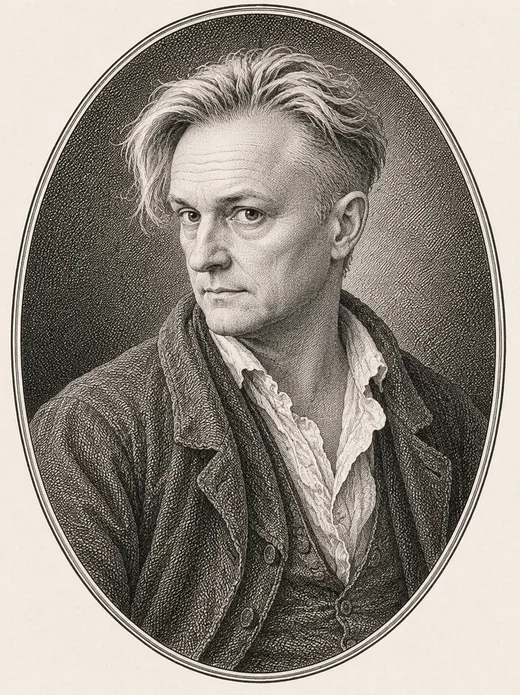
When I first met Denis Diderot in high school Western Civilization it was during the Enlightenment chapter, which is a sentence that makes the encounter sound considerably more dramatic than it was.
Diderot was the guy who spent twenty-one years and twenty-eight volumes trying to gather, organize, and publish the knowledge of his age, which was exactly the sort of absurdly ambitious project that appealed to me. So I filed him away accordingly: The Encyclopedia Guy.
I didn’t yet know enough about him to know how deliciously appropriate my nickname was.
A few years later, I encountered him again in a college French literature class. By then, languages were already a significant part of my life. I had trained as a Russian translator and interpreter in the Army, where translation meant considerably more than replacing one word with another. Translation requires recognizing missing cultural context, noticing when something doesn’t cross neatly into English, and interrogating the gap until you understand what is happening well enough to get across it.
I had also studied French for four years and spent the previous summer living in Paris. That did not make me an eighteenth-century Frenchman. It did, however, mean that when I signed up for a French literature elective, reading a novel in French did not strike me as an especially reckless thing to do.
Then somebody assigned Jacques le fataliste et son maître.
Holy fuck.
Not because it was written by the Encyclopedia Guy. I knew that, but it wasn’t the revelation. The revelation was recognition.
I do that.
In Jacques, Diderot takes a question and refuses to leave it alone. He starts telling a story, interrupts it, argues with the reader about the interruption, wanders somewhere else, returns to the original question from an angle that makes it look slightly ridiculous, and then discovers that the ridiculous angle has exposed something the straightforward one couldn’t. He pulls things apart, makes fun of the pieces, puts them back together, and seems almost offended when they fit too neatly.
Most importantly, he doesn’t stand safely outside any of it.
The narrator is implicated. Jacques is implicated. His master is implicated. The reader is implicated. Even the conventions of the book are fair game. If some piece of the machinery starts pretending it has authority it hasn’t earned, Diderot reaches over and rattles it.
I knew that instinct.
I’ve been the class clown for most of my life. Humor was never just a way to get a laugh, although the little dopamine hit from getting the laugh certainly didn’t hurt. Sometimes the joke was the fastest way to find the weak spot in an argument. Take what someone has said completely seriously, extend it just a little farther than they intended, and suddenly there it is: the assumption nobody had noticed because everyone had politely stopped one step earlier.
Sometimes the joke fails, of course. Sometimes you’re not exposing an assumption, you’re just being an asshole. Useful information, both.
What Jacques showed me was the range of the instrument.
Diderot didn’t make the joke and then return obediently to the serious business. The joke was serious business. So was the interruption. So was the detour. He could interrogate the structure of an argument by messing with the structure carrying it. He could follow an apparently unnecessary diversion until it became clear that the diversion had been doing the real work all along.
And he could keep doing it. That was the part that got me.
Jacques wasn’t a clever paragraph or an occasional trick. Diderot milked the thing for something like a hundred thousand words. 100,000!-ish (the editors made me put the -ish there, since I wouldn’t stop insisting).
He kept testing the inquiry, the story, himself, and me. Every time I thought the damned book had finally agreed to behave, it noticed me expecting it to and made that expectation part of the problem. I was in love with a dead Frenchman. I wasn’t the first, I was sure. This was a French lit class, after all.
There is another clever twist I would learn much later. The object I encountered in college, a finished book with Jacques le fataliste et son maître printed smartly on its cover, Diderot’s name embossed below, a reassuringly fancy publisher colophon below that, was not the object through which its first readers encountered it.
BORING HISTORY LESSON: Jacques circulated serially through the Correspondance littéraire between 1778 and 1780. By then Friedrich Melchior Grimm, whose name remained attached to the enterprise, had handed editorial responsibility to Jacques-Henri Meister. Then some dudes copied it out. By hand. With quills. Probably. However they produced it, the first French printed edition didn’t appear until 1796, twelve years after Diderot died.
So the thing I encountered in college as a book, complete with all the authority and permanence we instinctively grant bound objects, first reached a very limited audience, in pieces, in handwriting hopefully better than mine, spread out over years. Diderot effect, indeed.
Ink has posture. A bound novel tells you that you are holding a novel before you have read the first sentence. Diderot’s earliest readers would have received something rather stranger, arriving in pieces through a private manuscript correspondence. The book I held in college had acquired a physical certainty that the thing Diderot was making never had. Shitty handwriting doesn’t have quite the same cachet.
There is something appropriate about that, because certainty is one of the things Jacques enjoys worrying at.
I don’t remember exactly where I was sitting when the recognition happened. I don’t remember which passage did it. Memory has helpfully declined to provide the cinematic details an essayist might like to have available several decades later. Et puis en ce moment, j'ai une mémoire de merde.
But I do remember the recognition.
The Encyclopedia Guy had suddenly become a problem. This was the advanced course and I wanted more. Denis Diderot.
The Class Clown thought:
I do that.
I can do that.
I am going to keep doing that.
Boss level.
Sources & Notes
Diderot, Denis. Jacques le fataliste et son maître. Source →
Primary text for the interruptions, digressions, arguments with the reader, and general refusal to behave like a well-trained novel.
Bibliothèque nationale de France Jacques le fataliste et son maître, conventional-title record. Source →
For the publication history: serialization in the Correspondance littéraire from 1778 to 1780, later additions, and the first complete French edition in 1796.
Stanford Encyclopedia of Philosophy Denis Diderot. Source →
For Diderot’s broader intellectual and literary context, including the inconvenient fact that much of the Diderot we now know was not available to his contemporaries in printed books.