
01 / The man
The Encyclopedia Guy; or,
De l’art de rester hors de la catégorie imprimée sur la couverture
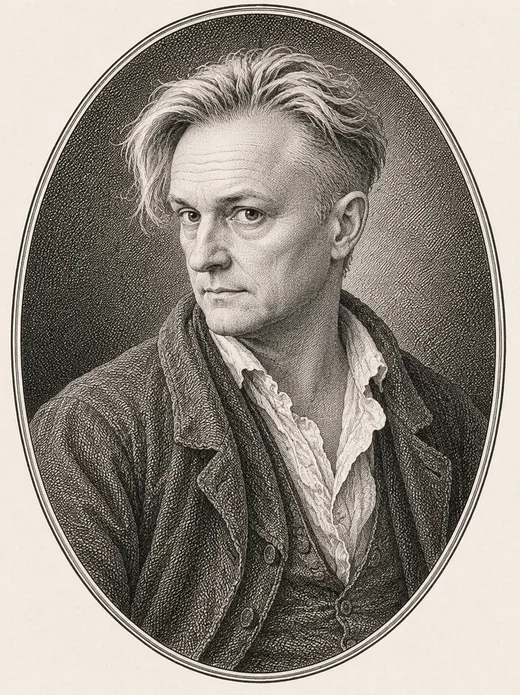
Denis Diderot was born in Langres, France, in 1713. He was the son of Didier Diderot, master cutler, which is one of the few biographical facts whose mouth feel alone almost justifies its preservation.
The easy version is that he was a French Enlightenment philosopher and writer best known as the principal editor of the Encyclopédie, the enormous eighteenth-century attempt to collect and organize human knowledge. No one around here likes easy.
Diderot spent decades on the Encyclopédie project, working with Jean le Rond d’Alembert and a sprawling cast of contributors to produce twenty-eight volumes of text and plates between 1751 and 1772.
When I first encountered him, I was more interested in the project than the project manager. To me, Denis became The Encyclopedia Guy.
Perfectly accurate at the time. Woefully inadequate today.
Diderot also wrote novels, plays, art criticism, philosophy, dialogues, letters, essays, and works that become harder to classify the longer you look at them. He wrote La Religieuse, Le Neveu de Rameau, Jacques le fataliste et son maître, Le Rêve de d’Alembert, and Supplément au voyage de Bougainville. Some appeared during his lifetime. Some circulated privately. Some were published only after his death. Some seem almost constitutionally opposed to remaining inside the category printed on their cover.
This was not entirely an accident.
Diderot liked taking an idea seriously enough to make trouble for it. He argued through dialogue, contradiction, interruption, satire, thought experiment, fictional characters, real people turned into fictional characters, and occasionally himself. He could begin with a dressing gown and end up worrying at identity, consumption, and the strange authority objects acquire over the rooms around them. He could review a painting and wind up arguing with his own face.
He was also imprisoned. In an actual prison. The French kind.
In 1749, after publishing the Lettre sur les aveugles à l’usage de ceux qui voient, Diderot was arrested and confined at Vincennes. The essay begins with blindness, perception, and how we know what we know, then proceeds into materialism and some rather dangerous questions about religious orthodoxy. Robespierre wouldn’t be born for another nine years, but France was already laying out enough intellectual kindling to keep that generation occupied.
He was released after several months. The experience did not transform him into a more cautious writer, although it did give him excellent evidence that ideas were not being treated as harmless entertainment.
His relationship with authority remained complicated. The Encyclopédie was censored and suppressed. Diderot kept working on it. He depended at various points on patrons, publishers, subscribers, friends, and eventually Catherine the Great of Russia, who solved one of his financial problems by buying his library and then, rather wonderfully, leaving it with him and paying him to serve as its librarian.
Diderot died in Paris in 1784. Five years before, uh, some other stuff I really wish he’d been able to write through.
That date is more inconvenient than it looks. Several works for which Diderot is now famous were not published as French books during his lifetime. Jacques le fataliste, for example, circulated through the manuscript Correspondance littéraire before appearing in a French printed edition in 1796. The Diderot available to his contemporaries and the Diderot available to us are therefore not quite the same object.
Which seems appropriate.
He spent much of his life trying to organize knowledge while repeatedly producing work that resisted tidy organization. Philosopher. Novelist. Critic. Dramatist. Encyclopedist. Materialist. Satirist. Editor. Troublemaker.
Inspiration.
All accurate. Pick one and something starts rattling.
Sources & Notes
Stanford Encyclopedia of Philosophy Denis Diderot and biographical supplement. Source →
For Diderot’s life, range of work, the Encyclopédie, his imprisonment, and Catherine the Great’s purchase of his library.
Bibliothèque nationale de France L’Encyclopédie, conventional-title record. Source →
For the project’s dates, Diderot and d’Alembert’s direction, and the seventeen volumes of text plus eleven volumes of plates.
ARTFL Encyclopédie, University of Chicago Publishers’ letter concerning Diderot’s detention, 24 July 1749. Source →
A contemporary document connecting Diderot’s imprisonment at Vincennes with his work on the encyclopedia project.