
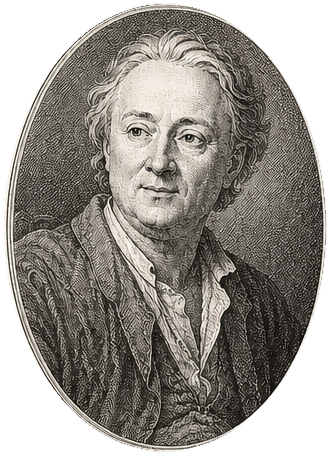
after seeing this portrait by
Louis-Michel van Loo, 1767:
« Mes enfants, je vous préviens
que ce n’est pas moi. »
The Diderot Corner
The Philosophes
A working corner, not a shrine.
Denis Diderot has been dead since 1784, which has done surprisingly little to keep him out of our work. More Taste Than Fortune Books takes its name from him. Our colophon is the belt from his old dressing gown. “My friends, keep your old friends” is his. At some point, calling all of that inspiration starts to seem inadequate.
Diderot is our intellectual patron, not because we agree with everything he wrote or because an eighteenth-century French philosophe provides convenient historical gravitas for a publishing house. God help us. He matters here because of the way he thought: worrying at ideas, distrusting categories that became too comfortable, following detours to see where they went, implicating himself in the questions, and using humor as an instrument of inquiry.
Writer. Philosopher. Encyclopedist. Critic. Professional complication. Inspiration.
He turns up in Chapter 13 of Embracing the Local, where a dressing gown helps explain how improving one thing can quietly reorganize everything around it. That book only exists because I eventually fell prey to much the same effect at the Chamber: I found one thing to change. Hilarity ensued. New Year, New Diderot.
And every so often, we discover that something we thought we had arrived at independently has his fingerprints on it, too. We recognize the instinct, sometimes retrospectively. That is why this corner is plural. Diderot is the gravitational center, but Grimm, Meister, d’Alembert, Rousseau, and the rest of the unruly eighteenth-century machinery have a way of wandering into the room.
« Mes amis, gardez vos vieux amis. Mes amis, craignez l’atteinte de la richesse. »
The Philosophes is where I make that relationship explicit: where I read Diderot, argue with him, borrow his tools, test them against lived experience, and occasionally discover that he has already been somewhere I thought I had arrived on my own. Things may get rattled.
Reading Diderot
The Encyclopédie was an argument about knowledge as much as a collection of it, about who gets to gather it, how it gets sorted, and who is allowed to speak with authority about any of it, and that argument has only gotten louder now that the machines have joined in. Artificial Polemics, five essays about artificial intelligence, writing, judgment and evidence, is where I’ve been having it. Diderot rarely appears in them, though the habits of inquiry they depend on owe him a great deal, and since the philosophes remain unavailable for comment, I’ve carried on the interrogation in their spirit.
More to come
Diderot kept writing. So will we.
This corner will grow as the questions do.